
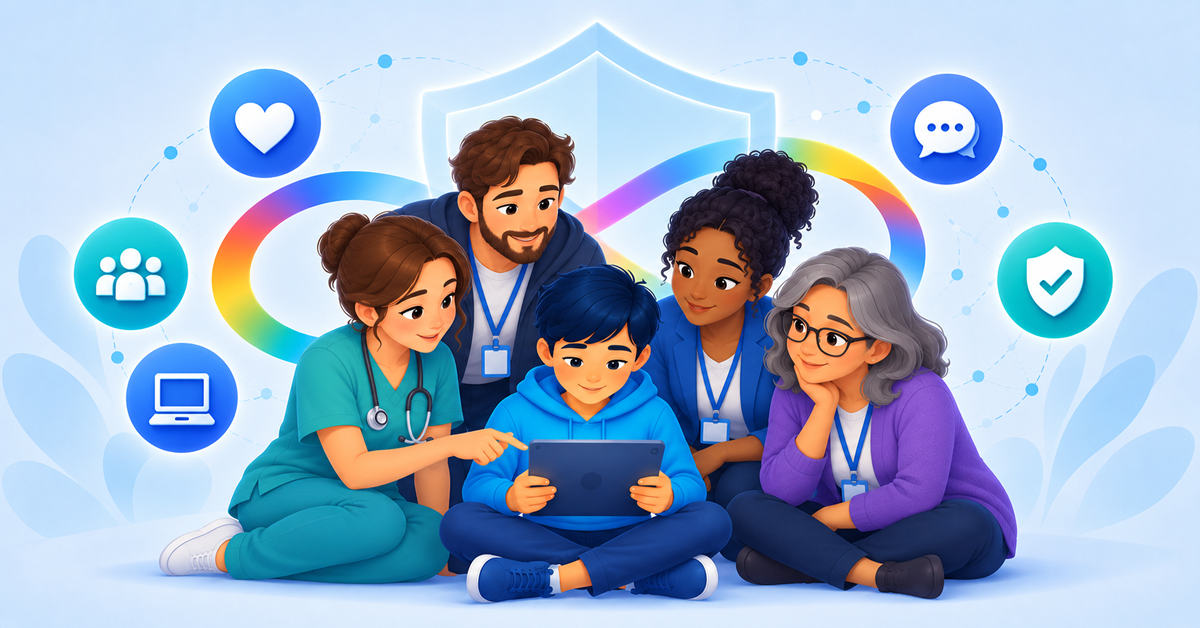
Digital participation reaches well beyond school and home; health, social care, youth, voluntary and community services can all help autistic children and young people use technology safely, confidently and in ways that support inclusion and independence.
A Shared Role in Digital Wellbeing
Safe Internet and Digital Use for Children with Autism (SIDUCA) guidance is also for professionals and organisations that would not usually describe their work as online safety but who regularly support autistic children, young people and families. This includes health and social care staff, social workers, support workers, therapists, youth workers, family-support services, charities, community groups, clubs and activity providers.
Digital experiences can affect wellbeing, relationships, behaviour, sleep, access to services and participation in everyday life; professionals may notice changes or receive disclosures even where online activity is not the original reason for contact. Knowing the main digital risks, the benefits of online participation and the correct referral routes is now a practical part of person-centred support.
Understanding the Person and the Context
There is no predictable set of online needs that follows from an autism diagnosis; support should take account of communication, understanding, sensory preferences, emotional regulation, interests, previous experiences, family circumstances and the person’s ability to recognise and respond to changing situations.
Professionals should avoid treating all digital activity as a problem; whilst online spaces may provide valuable opportunities for learning, identity, friendship, communication and reduced social pressure – the better starting point is the person’s own circumstances i.e. what is happening, what the actual concern is and what can be done without taking away useful access unnecessarily.
Recognising and Responding to Concerns
Relevant issues may include bullying, harassment, grooming, exploitation, coercion, scams, financial pressure, compulsive use, exposure to harmful or sexual content, contact with strangers, misinformation, privacy breaches or difficulties interpreting relationships and boundaries.
A concern may be disclosed directly or appear through changes in mood, routine, spending, device use, relationships or willingness to attend activities. These signs do not prove that online harm has occurred, but they may justify a calm conversation and, where appropriate, action under the organisation’s safeguarding procedure; immediate risk should be referred to emergency or statutory services through established routes.
Clear and Accessible Support
Advice is more useful when it is specific; rather than telling someone simply to ‘stay safe’, support may involve explaining a situation in concrete terms, rehearsing how to leave a conversation, showing how to block or report an account, identifying trusted people, or agreeing what to do if the same issue happens again.
SIDUCA will turn that approach into plain-language guidance, recognisable scenarios and activities that can be adapted to the setting; they will be designed to sit alongside professional assessment, care planning, safeguarding practice and the policies of the organisation using them.
Joined-Up Working and Information Sharing
Where several services support the same child or young person, consistent messages can reduce confusion; collaboration should have a clear purpose and respect consent, confidentiality, data protection and safeguarding law. Only relevant information should be shared, through suitable channels, with the person’s rights and dignity kept in view.
Organisations should also consider whether staff understand online risks, know how to record and escalate concerns, and can distinguish an educational need from a situation requiring specialist or statutory intervention.
Partnership and Consultation
Health, care and community organisations can help SIDUCA understand how digital safety support works in varied settings; future partnership opportunities may include consultation, resource review, pilot delivery, professional training and signposting.