Introduction
Children do not experience their online and offline lives as separate worlds.
An argument may begin during an online game at home and continue between pupils at school, photograph taken during the school day could be shared later through a private account, or a child might tell a teaching assistant about a worrying message but need a parent to help manage the account involved.
When home and school respond in very different ways, the child can receive conflicting messages about what should be reported, who can help and which rules apply.
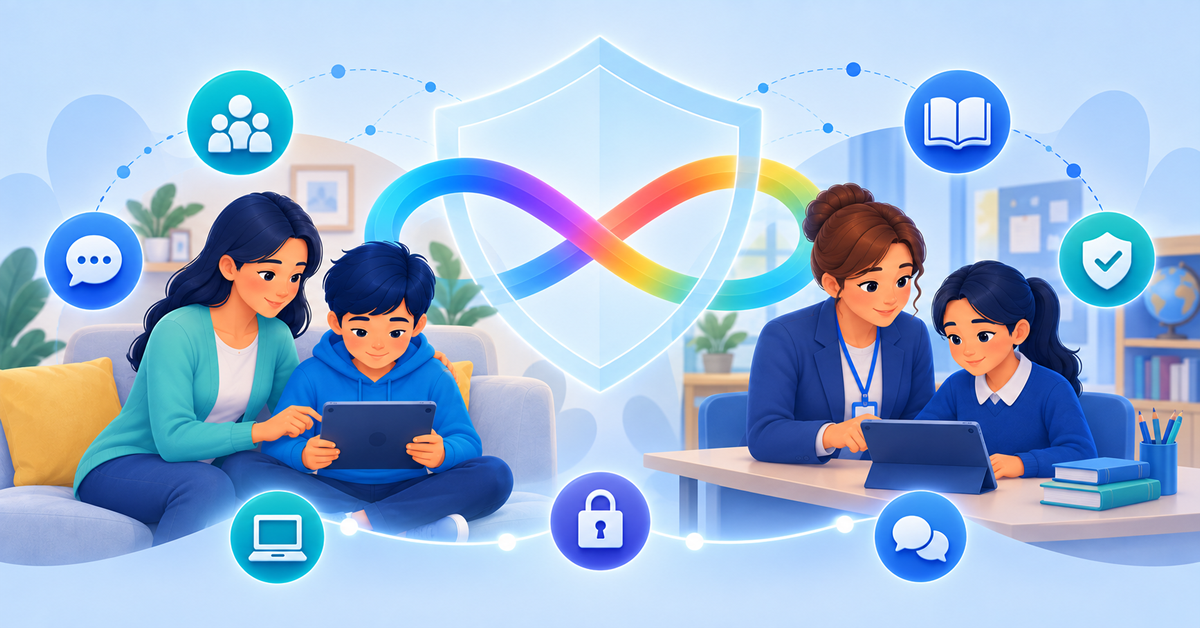
Families and schools have different responsibilities i.e. parents and carers make decisions about personal devices, accounts and supervision at home; whilst schools have safeguarding duties, behaviour policies and responsibility for technology used within the education setting.
Some incidents fall across that divide; the fact that something happened outside school hours does not mean it has no effect in school. Online bullying may affect attendance, concentration, wellbeing and relationships between pupils; equally, problems that begin during the school day can continue through messaging or gaming platforms at home.
Good communication helps both sides understand what has happened without assuming that the other must deal with it alone.
Clear and Compatible Guidance
Children may find it harder to apply online safety learning when the language changes completely between settings.
A school might teach a “stop, check and tell” routine while the family uses different words for the same actions; neither approach is necessarily wrong, but the connection may not be obvious to the child.
Using compatible terms for important ideas can reduce confusion; this may include the language used to describe private information, an uncomfortable message or the process for asking for help.
Consistency does not require identical rules at home and school, it means making the central safety message recognisable in both places.
Information sharing should also have a clear purpose; families and schools do not need unrestricted access to every part of a child’s online activity, instead they may need to share enough information to address a concern affecting safeguarding, wellbeing, behaviour or learning.
Parents should know whom to contact at school; schools should explain what they can reasonably do, where their authority ends and when another organisation may need to become involved.
Where appropriate, the child should be told what information is being shared and why; safeguarding responsibilities may prevent complete confidentiality, but the process should not be made more secretive or confusing than necessary.
Support That Adapts
Online independence is likely to change as a child grows older; new devices, wider social networks and different expectations may introduce situations that earlier teaching did not cover.
Transitions between classes, schools or services can also disrupt useful arrangements; a child may already have a reliable way to report an online concern or a known difficulty interpreting certain messages and losing that information means support may have to be rebuilt from the beginning.
When an incident does occur, the first discussion should establish whether anyone is at risk, what evidence should be retained and what the child needs. Questions about where the problem began or who should have prevented it can be considered once the immediate concern is under control.
Safe Internet and Digital Use for Children with Autism (SIDUCA) is intended to complement the arrangements already used by families, schools and safeguarding professionals; future resources for these audiences should connect where it is helpful.
A classroom activity might include information for parents, while family guidance could explain when involving the school would be appropriate.
Home and school will not agree on every detail; a workable approach depends more on clear roles, proportionate communication and a shared understanding that online experiences can affect every part of a child’s life.